
Quick Answer
A professionally installed tub-to-shower conversion in Seattle costs $14,000–$22,000 and is typically completed in one to three days. Price depends mostly on wall material — fiberglass starts around $14,000, stone-look solid surface runs $16,000–$18,000, and custom tile is quoted per project.
Who converts a tub to a shower — and why
Almost nobody wakes up one morning wanting a construction project. What happens is quieter than that.
You notice you haven't actually taken a bath in four years. You notice you brace a hand on the wall stepping over the tub wall. You notice the caulk line has gone gray no matter what you scrub it with, and that the drywall above the tile is starting to bubble. Or your parents visit and you watch your father hesitate for a second before he steps in.
That's the moment. And the conversion — swapping a bathtub you don't use for a shower you use every single day — is the highest-return change most Seattle homeowners can make in a bathroom.
It's also a genuinely modest project. You're not moving walls. You're using the exact space the tub already occupies, which is why it can be done in a day.
What a tub-to-shower conversion costs in Seattle (2026)
| Wall material tier | Starting price | What you get | Cleaning reality |
|---|---|---|---|
| Good — fiberglass | From about $14,000 | Seamless, non-porous walls to the ceiling, new base, fixtures, glass | Wipe with a cloth. No grout, nothing to scrub |
| Better — stone-look solid surface | About $16,000 – $18,000 | Swanstone and equivalents. The depth and texture of stone in a solid, groutless panel | Same as above, with a more premium look |
| Best — custom tile | Quoted per project | Full design freedom: pattern, format, niches, natural stone | Grout lines require periodic sealing and cleaning |
Custom tile is priced individually because the tile you choose drives the number. Porcelain subway and hand-cut marble mosaic take similar labor and cost very different amounts in material. We price it once you've picked, not before — and you see the line items.
Included in every tier
Demolition and haul-away, inspection of the framing and subfloor behind the tub, waterproofing, the drain conversion, the new shower base, wall system to the ceiling, valve and fixtures, and the glass or curtain configuration you choose.
What can add to it
Rot in the subfloor or bottom plate discovered at demo, a supply line that shouldn't be reconnected, frameless heavy glass, a built-in bench, body sprays or a thermostatic valve, and heated flooring.
The drain rule nobody tells you about
Here's the technical detail that surprises the most homeowners in Seattle, and the reason a DIY conversion kit from a big-box store is a bad idea in this city.
The 1.5" vs 2" rule
Bathtubs drain through a 1.5-inch line. Showers require a 2-inch line. Water leaves a shower faster than it leaves a tub, because a tub is designed to hold it. Seattle's plumbing code reflects that.
So converting a tub to a shower isn't just swapping the fixture on top — it means opening the floor, upsizing the drain, and re-establishing the trap and vent correctly.
That's also why this project requires a plumbing permit in Seattle, even though nothing moves. It's a fixture alteration, not a like-for-like replacement. Full permit guide here.
If someone quotes you a conversion that doesn't mention the drain, they are either planning to leave the old 1.5-inch line in place — which will pool water at your feet and eventually fail inspection — or they haven't thought the job through. Ask the question directly.
How long it takes
| Phase | Timeline |
|---|---|
| In-home consultation and written quote | Same visit |
| Material selection | Same visit or within a few days |
| Permit (where required) | 1–3 weeks, handled by us |
| Installation | 1–3 days |
| Final walkthrough | Last day, with you present |
Most conversions we do are complete in a single day — demo in the morning, new system in by evening, usable the next morning after the sealant cures. Two or three days happens when tile is involved, or when demo reveals framing that needs to be rebuilt before anything new goes in.
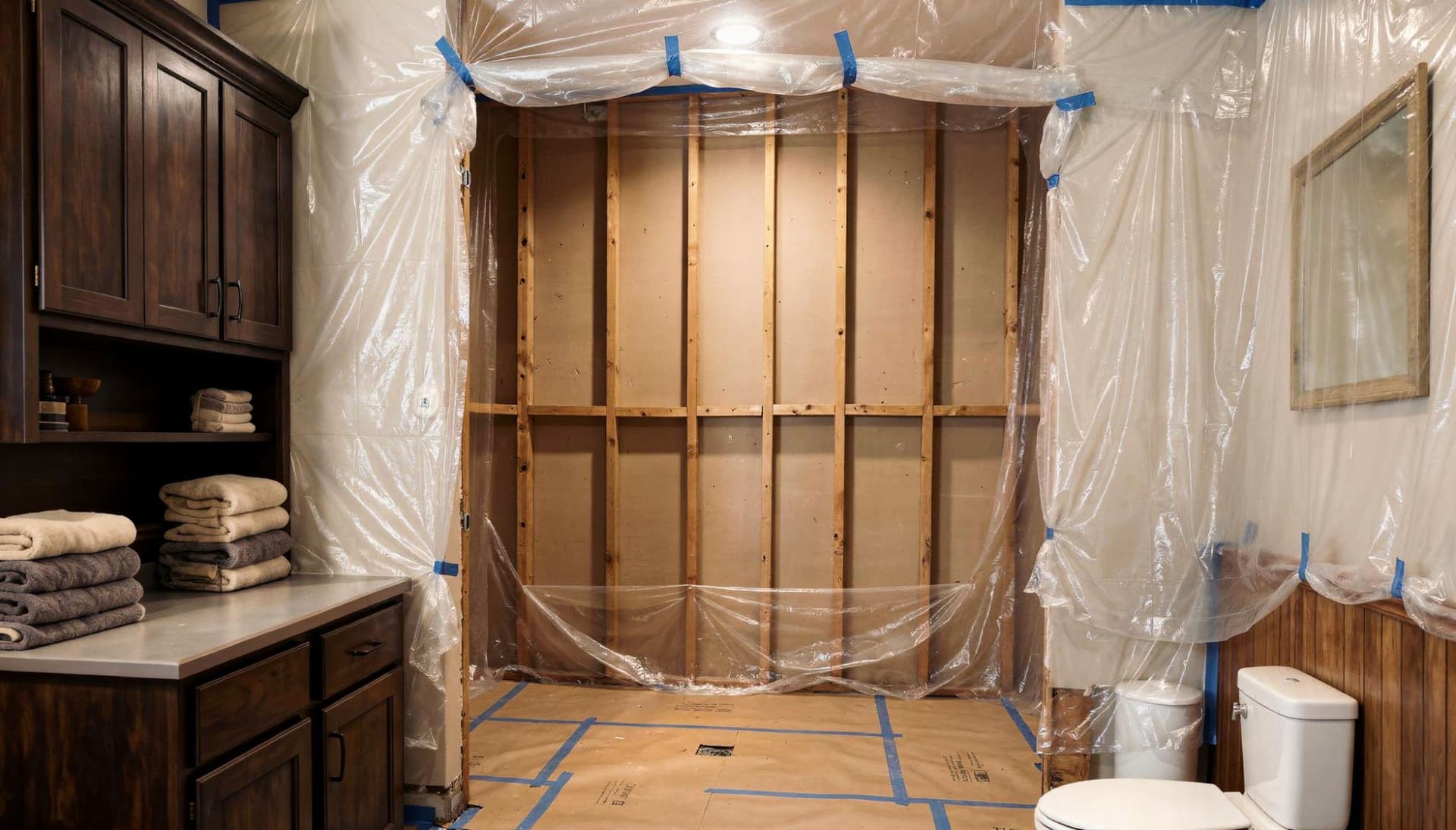
Compare that to a traditional gut remodel, which puts your primary bathroom out of service for three to six weeks. Here's how we do it that fast without cutting the parts that matter.
Choosing your wall material: an honest comparison
Fiberglass (the Good tier)
Fiberglass has a reputation problem, and it's fair. The thin, flexing insert in your first apartment was fiberglass, and so is the yellowed unit we pull out of 1980s bathrooms most weeks.
What we install is a different product: a thick, molded panel with a durable gel-coated surface, formed with the corners and seams integrated. It doesn't flex when you lean on it, doesn't absorb water, doesn't stain, and has no seams for mildew to colonize. The old units failed because they were built thin to hit a builder's price point and the wall behind them was rarely waterproofed — both installation problems, not material problems.
Choose it if: low maintenance is your priority, you want the fastest installation, or your budget is the deciding factor.
Skip it if: you want a specific tile pattern or natural stone look you can't get in a molded panel.
Stone-look solid surface (the Better tier)
Solid surface panels — Swanstone and comparable products — give you the visual weight and texture of stone tile in a single groutless sheet. From three feet away, most people can't tell it isn't tile. From a cleaning standpoint, the difference is enormous.
Choose it if: you want the look of a tiled shower and the maintenance of a solid panel. This is the tier most of our Seattle customers land on, and it's the one we'd pick for our own homes.
Skip it if: you want a truly custom pattern or a specific natural stone.
Custom tile (the Best tier)
Tile is the only option that gives you complete design control — herringbone, large-format porcelain, a marble niche, a contrasting floor. It's beautiful and it's the traditional choice for a reason.
Choose it if: design specificity matters more to you than maintenance, and you're prepared to reseal grout periodically.
Skip it if: the phrase "scrubbing grout" makes your shoulders tense. Be honest with yourself here — it's the single most common regret we hear.
Threshold height: the choice that matters more than you think
A standard shower base has a small curb — usually four to six inches. A zero-threshold (or curbless) base is flush with the bathroom floor.
If anyone in your household is over 60, has a mobility issue, or you plan to be in this house for another fifteen years, choose the low or zero-threshold option now. The cost difference at installation is modest. Retrofitting it later means tearing out a shower you just paid for.
It doesn't look institutional. Done well, a curbless shower is the most modern-looking thing in the room — which is exactly why it's showing up in high-end new construction. We wrote about that here.
Will removing my only bathtub hurt resale value in Seattle?
This question comes up constantly, so here's the direct answer.
If it's your home's only tub, keep a tub somewhere — in a second bathroom, if you have one. Families with small children do filter for at least one bathtub, and in family neighborhoods like Ravenna, Wallingford, and West Seattle, that matters.
If you have two or more bathrooms, converting the primary to a shower is almost always a net positive. Buyers in Seattle read a walk-in shower as an upgrade, not a subtraction. And the segment of the market that's growing fastest — homeowners planning to stay in place into their seventies — actively wants one.
More on how upgrades translate to value in our Seattle bathroom remodel ROI guide.
Tub-to-shower vs. the alternatives
| Option | Cost | Timeline | Best for |
|---|---|---|---|
| Tub-to-shower conversion | $14,000 – $22,000 | 1–3 days | Homeowners who never use the tub and want easier, safer daily use |
| Bathtub replacement | $12,000 – $20,000 | 1–2 days | Households that genuinely use a bath, or a home's only tub |
| Walk-in tub | $12,000 – $25,000 | 1–2 days | Someone who wants a full soak and needs safe entry |
| Full gut remodel | $22,000 – $48,000 | 3–6 weeks | Layout changes, moving plumbing, redesigning the whole room |
Not sure between a conversion and a walk-in tub? We compare them directly here.
What to ask before you sign
Are you upsizing the drain to 2 inches?
The answer must be yes.
Who pulls the permit?
It should be them.
What happens if you find rot behind the tub?
You want: "We show it to you and price it before we proceed."
Is the wall system going to the ceiling or stopping at showerhead height?
To the ceiling is the answer that lasts in this climate.
What exactly does the warranty cover, and for how long?
Get the specifics in writing, not a slogan.
Can I see three finished projects in my area?
A real local track record should be easy to produce.
Any contractor who gets impatient with these questions is telling you something useful.
Frequently Asked Questions
See what your bathroom could look like
Book a free in-home consultation or call (425) 345-5194 — we'll measure, look behind the walls, and give you a written quote on the same visit.