
Seattle homeowners have always had an intimate relationship with nature. From the cedar forests of the Cascades to the rocky shoreline of Puget Sound, the Pacific Northwest aesthetic is rooted in organic textures, muted earth tones, and the kind of quiet calm you can only find surrounded by trees. Now that sensibility is moving indoors — and the bathroom is where it's making the biggest impact.
Biophilic design, the practice of incorporating natural elements and patterns into interior spaces, is the dominant bathroom trend in Seattle's remodeling market right now. And for homes in Capitol Hill, Ballard, Queen Anne, and the Eastside suburbs, it makes more design sense than almost anywhere else in the country.
This article breaks down what biophilic bathroom design actually looks like in practice, which elements deliver the most visual impact, and how Seattle Bath Remodels approaches this trend for Pacific Northwest homes specifically.
What "Biophilic" Actually Means in a Bathroom Context
Biophilic design doesn't require you to grow moss on your walls or install a koi pond next to your toilet. In practical terms, it means designing a space that evokes the feeling of being in nature through:
- Materials that mimic natural textures — stone-look panels, wood-tone finishes, earthy grays and greens
- Light that feels organic rather than clinical, whether from skylights, frosted glass, or warm-spectrum fixtures
- Color palettes drawn from the surrounding environment — the slate grays of Elliott Bay, the deep forest greens of Discovery Park, the warm amber of cedar
- Organic forms rather than sharp geometric lines — curved niches, irregular mosaic accents, river-stone floor tiles
The goal is a bathroom that doesn't feel like a room inside a house. It feels like a pause in the middle of a forest.
Why This Trend Resonates Specifically in Seattle
Most national design trends arrive in Seattle and get filtered through the local lens. Biophilic design doesn't need to be translated — it already speaks the language of this city.
Seattle homeowners in neighborhoods like Madrona and Leschi are surrounded by old-growth Douglas fir, morning fog, and views of the Olympics. In Redmond and Kirkland, the Eastside landscape is defined by mossy trails and Lake Washington. Designing a bathroom that reflects that environment isn't a departure from your home's identity — it's an extension of it.
There's also a practical reason this trend is surging: Seattle's gray sky months. From October through April, natural light is a premium resource. Biophilic design strategies — lighter wall panels, reflective surfaces, warm-toned fixtures — compensate for the low-light environment in ways that purely modern or traditional designs don't.
Seattle-Specific Note
Homes built in the 1960s through 1990s in neighborhoods like Fremont and Wallingford often feature small, dark bathrooms with undersized windows and harvest-gold or avocado-green tile that was never going to age well. Biophilic remodels in these spaces are especially transformative because the contrast between before and after is dramatic.
The Four Elements That Define a Biophilic Bathroom
1. The Wall Panels
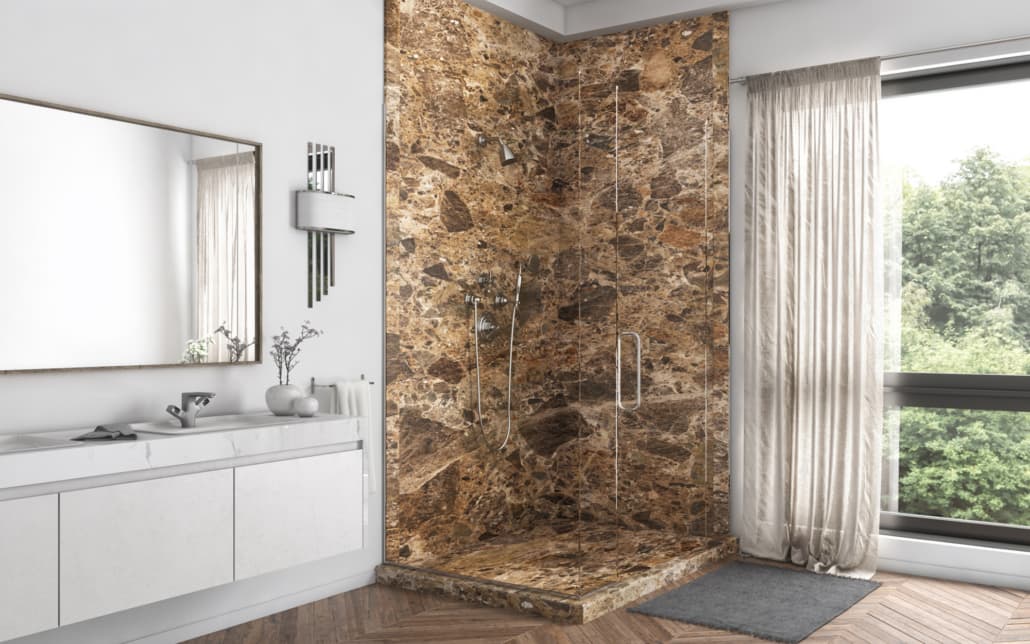
This is the single highest-impact element in a biophilic bathroom remodel. Stone-look acrylic panels — in basalt gray, slate green, sandstone beige, or weathered wood tones — replace traditional tile and create the foundational aesthetic of the entire space.
Unlike ceramic tile, modern panel systems can replicate the variation and depth of natural stone without the maintenance demands of actual stone. For Seattle homeowners especially, this matters: grout lines are mold-trapping liabilities in our humid climate, and large-format panels eliminate them entirely.
2. Fixtures in Organic Metal Finishes
Brushed nickel and chrome dominated bathrooms for decades. Biophilic design favors finishes that feel less manufactured: matte black (which reads as volcanic rock), brushed brass (warm, aged, organic), and oil-rubbed bronze (deep, earthy, timeless).
These finishes pair naturally with stone-look panels and wood-tone elements in a way that polished chrome simply doesn't.
3. Integrated Niche Lighting
Standard overhead bathroom lighting is the enemy of biophilic design. It's flat, clinical, and turns every shadow into a flaw. Integrated niche lighting — strips or point sources embedded within shower niches or below floating vanities — creates the kind of warm, directional glow that mimics dappled light through tree canopy.
4. The Floor-to-Ceiling Continuation
One of the defining moves of biophilic shower design is continuing the wall panel material from the shower walls up to the ceiling. This eliminates the visual "cut" at the top of the surround and creates an enveloping, immersive environment — the same effect you get standing under a granite overhang in the mountains.
What This Looks Like in a Realistic Seattle Bathroom
The majority of Seattle bathrooms earmarked for biophilic remodels are in the 45–70 square foot range — the standard footprint of a 1970s or 1980s master bath in Bellevue or Kirkland. The transformation typically involves:
- Replacing existing tile with large-format stone-look panels in a forest or slate palette
- Converting an unused garden tub to a walk-in shower with frameless glass
- Switching builder-grade chrome fixtures to matte black or brushed brass
- Adding a recessed niche with integrated lighting
- Selecting a vanity in a warm wood tone with a vessel sink in matte white or raw concrete
The result is a bathroom that looks like it belongs in a boutique lodge in Snoqualmie Pass — and functions like the high-performance, low-maintenance space Seattle's climate demands.
Frequently Asked Questions
Ready to Bring the Pacific Northwest Into Your Bathroom?
Seattle Bath Remodels specializes in high-impact shower and bathroom transformations completed in as little as one day. If you're ready to explore what a biophilic remodel would look like in your specific bathroom, the first step is a free in-home consultation.