
Seattle homeowners invest thousands in beautiful new showers and designer tile — and then vent all that steam through a 1970s exhaust fan that moves less air than a desktop fan. The exhaust fan is not a footnote in your bathroom. In the Pacific Northwest's climate, it is the frontline defense between a beautiful bathroom and a mold remediation project.
Why Seattle's Climate Makes Ventilation Non-Negotiable
Seattle averages approximately 38 inches of rainfall annually, spread across more than 150 days of measurable precipitation. During the October–May period, outdoor relative humidity regularly sits between 80 and 95 percent. A bathroom exhaust fan works by diluting moist bathroom air with drier outdoor air. In Phoenix (30% avg. humidity) a modest fan solves the problem quickly. In Seattle, where outdoor air is already carrying 80–90% humidity on most winter mornings, an undersized fan is functionally useless for most of the year.
The Seattle Humidity Reality
Most exhaust fan sizing guidelines were written for national averages. A fan rated "adequate" for a 50 sq ft bathroom may be genuinely insufficient in a Seattle home during winter months. Pacific Northwest installations should be sized at least one tier above the minimum recommended CFM rating.
The Four Stages of Ventilation Failure
Inadequate bathroom ventilation does not announce itself all at once. It progresses through predictable stages, each one more expensive to address than the last.
Persistent Mirror Fogging & Surface Condensation
Mirrors remain fogged 20–30 minutes after showering. Walls feel damp to the touch. Condensation forms on the window. These are the early warning signs that the fan is not keeping pace with moisture generation.
Grout Discoloration & Surface Mold
Grout lines begin to darken and discolor. Pink or black mold spots appear at the caulk line. Cleaning restores the surface temporarily, but the problem returns within weeks because the underlying humidity condition has not been resolved.
Behind-Wall Mold Colonization
Mold establishes itself in the wall cavity behind the shower surround. This phase is invisible — there are no outward signs beyond the Stage 2 symptoms. In our experience, this phase is active in approximately 40 percent of Seattle shower demolitions we perform.
Structural Damage & Remediation
Moisture has reached the subfloor, wall studs, or ceiling joists. Tiles begin to loosen or crack. At this stage, what began as a ventilation problem now requires full demolition, mold remediation, structural repair, and complete reinstallation.
CFM Sizing Reference — Seattle & King County Bathrooms
The Noise Test
If your bathroom fan sounds like a truck idling, your household is probably switching it off within 60 seconds. A fan rated at 1.0 sones or below will actually be used as intended. Fan noise is a behavioral adoption issue that directly affects whether the fan delivers its function.
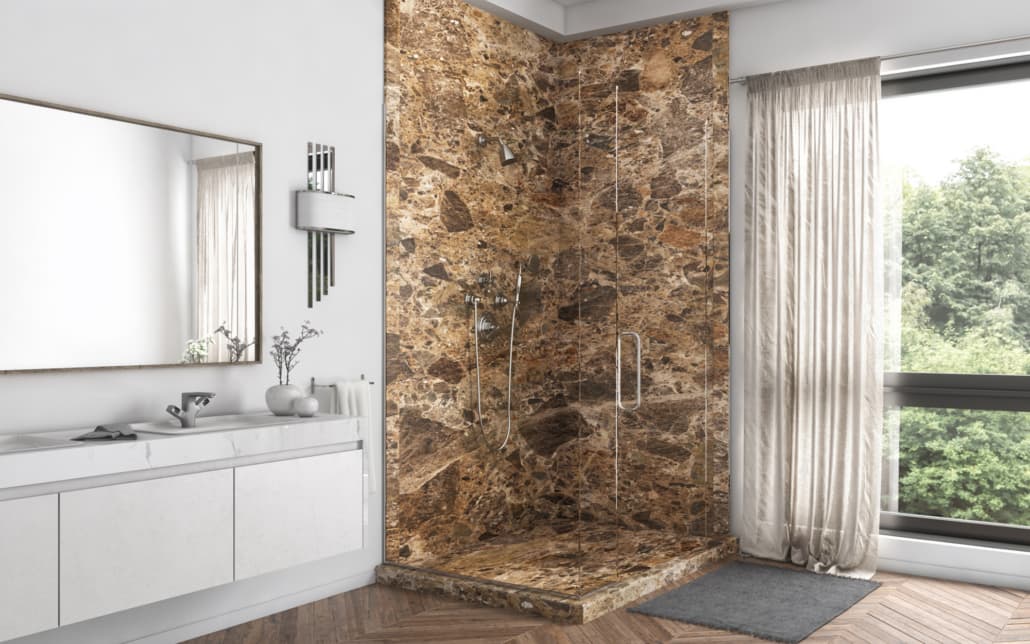
What Proper Ventilation Looks Like in a Seattle Renovation
Correctly Sized Fan with Humidity Sensing
Modern humidity-sensing exhaust fans automatically activate when relative humidity exceeds a set threshold (typically 70%) and run until humidity drops to an acceptable level. This eliminates the behavioral variable entirely — the fan does its job whether or not the occupant remembers to turn it on. For Seattle homes, humidity-sensing fans are not a luxury feature. They are the correct specification for the climate.
Hard-Ducted Exterior Venting
Many homes we work in have bathroom exhaust fans ducted into the attic rather than through the roof or exterior wall. Venting into the attic deposits moisture-laden bathroom air directly into the attic cavity — creating the same mold and structural damage risk as having no fan at all. Every renovation we complete verifies exterior termination and corrects any attic-venting situations.
Insulated Duct Runs
In Seattle's cool winters, uninsulated duct runs create condensation inside the ductwork itself. Insulated flexible duct in the 4 to 6-inch range, routed with minimal bends, is the correct specification for Pacific Northwest bathroom exhaust.
Our Approach
Every Seattle Bath Remodels project includes a ventilation assessment as part of the pre-construction inspection. If the existing fan is undersized, incorrectly ducted, or venting into the attic, we identify this at consultation — not as a surprise mid-project.
Your Bathroom Ventilation Self-Audit
Run through this checklist to understand your current situation. Three or more "yes" answers means your ventilation is actively working against your home.
- After a shower, does the mirror stay fogged for more than 15 minutes with the fan running?
- Does your fan make noise loud enough that you avoid turning it on when someone is sleeping nearby?
- Are there any visible mold spots on the ceiling, particularly near the shower or above the vanity?
- Do you know where your bathroom duct terminates — exterior wall, roof cap, or attic?
- Is your current fan more than 10 years old? (Fan performance degrades significantly over time.)
- Do you have a soaking tub or jetted tub with only a single standard fan in the room?
- Does moisture seem to collect around the window frame or on the inside of the window glass?
- Has it been more than two years since the fan cover was cleaned? (Dust reduces airflow dramatically.)
Frequently Asked Questions
Is Your Bathroom Ventilation Working Against You?
Every Seattle Bath Remodels consultation includes a full ventilation audit. We'll tell you exactly what your bathroom needs — and build it into your renovation from the start.
Related Articles
Home Maintenance
5 Signs Your Seattle Bathroom Is Quietly Failing
Design Tips
The Walls-to-Ceiling Advantage: Why Full-Height Shower Systems Are the Future
Quality Guarantee
The 5-Year Warranty Guarantee: Why Professional Installation Matters
Design & Innovation
Small Bathroom Remodel Ideas for Seattle Homes: Maximize Every Square Foot