
Seattle's craftsman bungalows, pre-war apartments, mid-century split-levels, and contemporary micro-condos share a common feature: bathrooms built for a different era of space expectations. If your bathroom feels impossibly small, you are in very good company across King County. The good news is that small bathrooms are not a design limitation — they're a design challenge.
The Single Most Impactful Change in a Small Seattle Bathroom
Before individual ideas, the single highest-leverage change available is eliminating the bathtub.
A standard 5-foot alcove bathtub occupies 15 square feet of floor space. In a 45 square foot bathroom, that's one-third of the total area dedicated to a fixture most Seattle adults use fewer than twice per week. Converting that footprint to a walk-in shower immediately reclaims usable space, eliminates the visual bulk of the tub surround walls, and — with a frameless glass enclosure — allows the eye to travel across the full width of the room uninterrupted.
Typical Small Seattle Bathroom
- 5-foot alcove tub consuming 15 sq ft
- Tub surround walls creating a cave effect
- Opaque shower curtain blocking light
- Grout lines chopping the visual space
- Single overhead fixture creating flat shadows
- Pedestal sink with no storage
After Seattle Bath Remodels
- Walk-in shower — open, frameless, floor-to-ceiling panels
- Continuous sight lines across the room
- Seamless wall system — no visual interruption
- Floating vanity creating floor continuity
- Layered lighting eliminating shadows
- Integrated niche storage — nothing on surfaces
9 Design Strategies That Make Small Seattle Bathrooms Feel Larger
Go Floor-to-Ceiling with the Shower Wall System
Shower walls that stop at showerhead height create a visual 'ceiling' inside the shower that psychologically compresses the space. Extending the wall system from floor to ceiling removes this boundary and allows the eye to travel upward continuously. Our large-format polymer panels make this technically simple and visually seamless — no grout lines interrupting the vertical flow.
Use a Frameless Glass Shower Enclosure
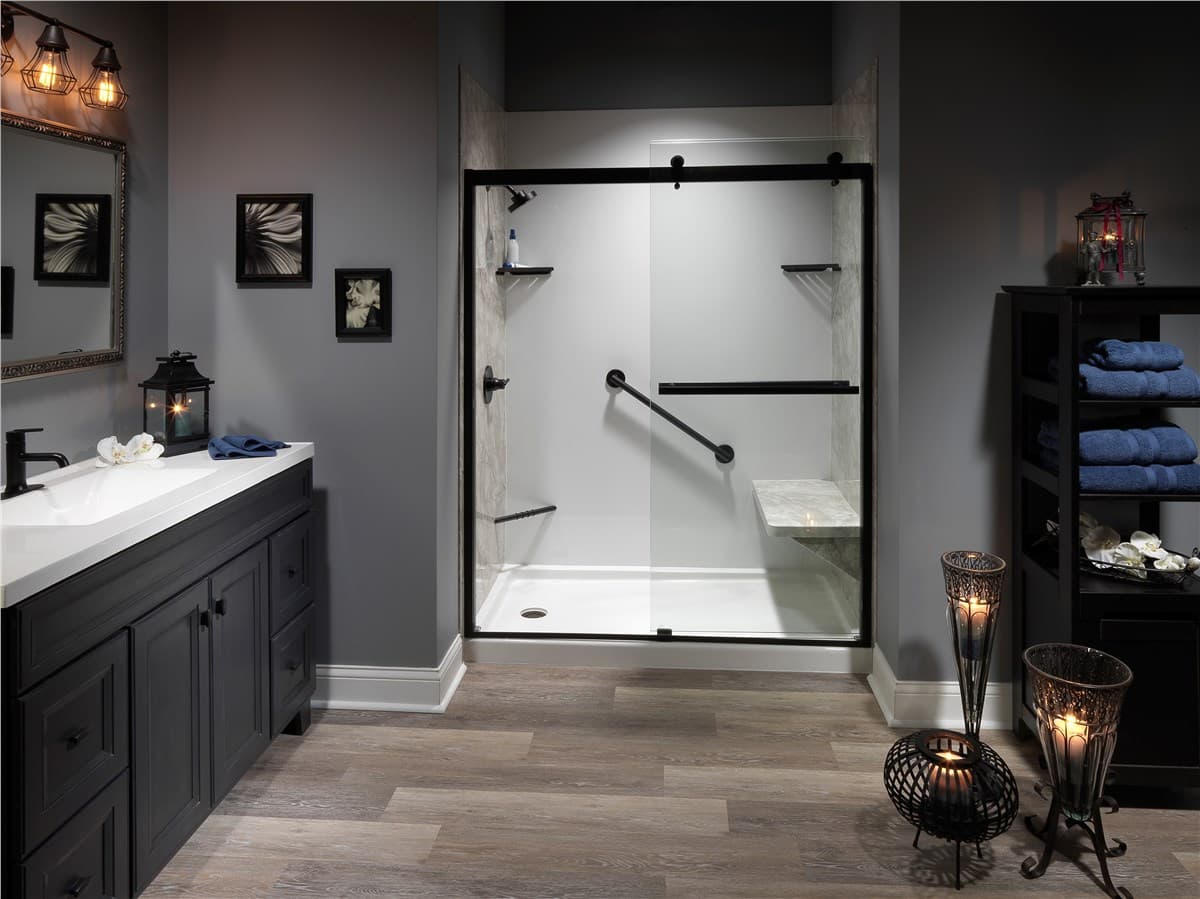
A framed door or shower curtain creates a visual barrier — a hard line that tells the eye the room ends there. A frameless glass enclosure is optically transparent: the eye continues past the glass into the shower space, reading the full depth of the room as open. In a 45 sq ft bathroom, this visual transparency can make the space feel 20–30 percent larger with no structural change.
Choose Large-Format, Low-Seam Wall Panels
Standard 4×4 or 12×12 ceramic tile creates a grid pattern across every surface. In a small room, a dense grid of lines visually subdivides the space into even smaller units. Large-format wall panels with minimal seams read as a single, continuous surface. The room feels calmer, cleaner, and significantly more expansive — the same principle architects use in luxury hotel rooms.
Install a Floating (Wall-Mounted) Vanity
A floor-to-cabinet vanity creates a visual stop — the eye lands on the base and the floor disappears. A floating vanity, mounted 12–15 inches above the floor, allows the floor to continue beneath it uninterrupted. This exposes more floor surface to view, which is one of the primary visual cues the brain uses to estimate room size.
Eliminate Surface Clutter with Integrated Niches
Shampoo bottles, soap dishes, and shower caddies create visual noise that makes small spaces feel chaotic. Built-in recessed niches — cut into the shower wall during installation — provide the same storage with zero visual footprint. Outside the shower, recessed medicine cabinets serve the same function at the vanity.
Use Consistent Tones Across Surfaces
High contrast between floor, walls, and fixtures creates visual boundaries that chop a small room into perceived zones. Using a consistent tonal palette — light walls with a slightly deeper floor in the same color family — allows the surfaces to read as a unified whole. Seattle's design sensibility tends toward warm whites, soft grays, and natural stone tones.
Layer Your Lighting
A single overhead fixture creates flat, shadowless light that flattens depth. Layered lighting — a recessed overhead for ambient light, sconces at the vanity mirror for task light, and optionally a small light inside the shower — creates depth and dimension. Rooms with multiple light sources feel more complex and larger than rooms with single sources.
Extend the Shower Pan to a Zero-Threshold Entry
A raised curb visually anchors the fixture to a specific zone of the floor. A curbless shower pan eliminates this step, allowing the floor to flow continuously from the vanity area into the shower. The single continuous floor surface reads as one unbroken plane, making the room feel significantly wider. Curbless showers are also the superior accessibility choice.
Maximize Natural Light — or Simulate It
If your bathroom has a window, use a frosted or obscure glass solution that admits full light while maintaining privacy. If there's no window — common in older Seattle apartment buildings — a full-spectrum LED system with high CRI values simulates natural light convincingly and makes small spaces feel considerably less cave-like.
The Seattle Context: Why Local Architecture Matters
Small bathrooms in the Pacific Northwest carry specific architectural signatures. Seattle craftsman homes (1905–1935) typically have load-bearing walls adjacent to the bathroom — a structural reality that limits layout changes without significant engineering. Balloon-framed walls in pre-war construction in neighborhoods like Wallingford and Phinney Ridge carry different plumbing considerations than platform-framed construction in newer Bellevue developments.
More practically: older Seattle homes frequently have 1950s and 60s plumbing configurations with cast iron drain lines that require specific approaches for shower base installation. Our team has worked in hundreds of homes across King County and understands these local construction realities.
One-Day Remodel Works Especially Well in Small Bathrooms
Because our wall panel systems are pre-configured to your exact dimensions before installation day, small bathrooms often complete faster than standard alcove spaces. A focused, single-day transformation means one day of inconvenience for a dramatically improved bathroom.
What to Prioritize When Your Budget Is Limited
If you cannot do everything at once, here is the priority order we recommend for small Seattle bathrooms based on impact-per-dollar:
- 1Convert the tub to a walk-in shower — highest spatial impact of any single change
- 2Install a frameless glass enclosure — transforms the visual openness of the shower conversion
- 3Upgrade the wall system to large-format non-porous panels — removes the grid visual and solves Seattle's mold problem simultaneously
- 4Replace the vanity with a floating model — significant visual impact at a relatively modest cost
- 5Add layered lighting — transformative and often underestimated impact on how the space reads
The Resale Perspective
In Seattle's real estate market, a well-executed small bathroom transformation often returns its cost upon sale. A small bathroom that looks and functions beautifully signals overall home care and quality — a disproportionately powerful selling point relative to its square footage.
Frequently Asked Questions
Let's Reimagine Your Small Seattle Bathroom
A free consultation includes a spatial analysis, layout recommendations, and material selection — designed around your specific bathroom and your specific home.
Related Articles
Luxury Design
Zero-Threshold Showers: The Ultimate Fusion of Modern Luxury and Universal Design
Design & Innovation
Why Settle for Half-Walls? The Case for a Full-Height Bathroom Transformation
Fast Remodeling
Remodeling in Days, Not Weeks: The Science Behind Fast Bathroom Remodels
Safety & Accessibility
Aging in Place: Expert Bathroom Safety Modifications for Seattle Independence